The robotics session at Grace Preparatory School gave more than 30 students direct contact with robots, sensors, programming logic and teamwork. For many learners, it was the first time robotics stopped being an abstract idea and became something they could touch, test and improve.
That shift is central to SEN's Robotics Bootcamp. A child can hear the word "robot" many times and still imagine something far away, expensive or reserved for experts. But the moment that child holds a component, watches a motor respond, or sees a line of code affect movement, the distance begins to close.
The Grace Prep session was designed to make that moment happen repeatedly. Students were grouped into teams, introduced to the parts of a robot, and guided through the logic behind sensing, movement and simple automation.
Why Robotics Works So Well for Young Learners
Robotics combines several kinds of learning at once. Students have to think mechanically because parts must fit together. They have to think logically because instructions must be ordered. They have to communicate because teams work better when roles are clear. They also have to handle failure because the first attempt rarely behaves perfectly.
That combination makes robotics a strong gateway into STEM. It does not ask students to simply memorize facts. It asks them to observe, predict, test, correct and try again. Those habits matter far beyond the robot on the table.
Inside the Session
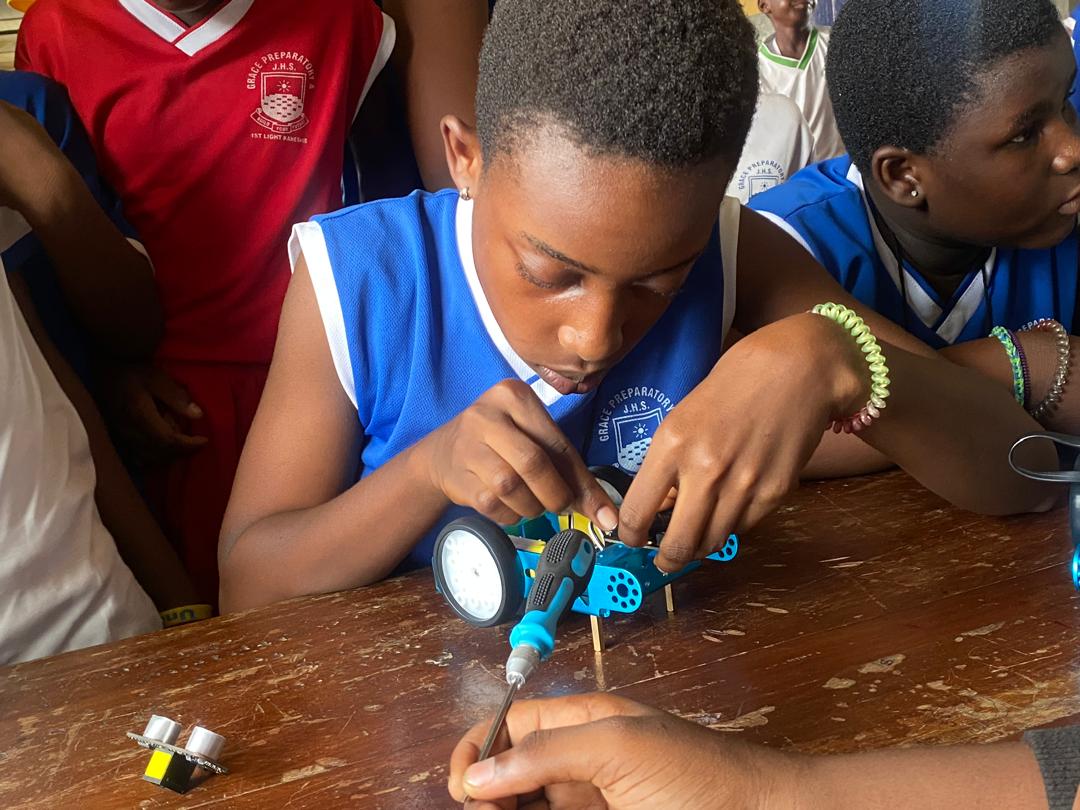
The session began with exploration. Students learned the basic parts of the robot, how motors create movement, how sensors help a robot respond to its environment, and how programming instructions guide behavior. The facilitators kept the explanations practical so learners could connect each concept to something visible.
After the introduction, students moved into team activities. They assembled, adjusted, tested and discussed. Some groups moved quickly. Others had to pause, rethink and troubleshoot. That was part of the learning. SEN facilitators did not treat mistakes as failure; they treated them as evidence that students were engaging with real engineering work.
"My favorite part was building a robot."
A response like that matters because it shows ownership. The student was not only entertained by robotics; they experienced themselves as a builder. That is the kind of confidence SEN wants to multiply.
What Students Practiced
- Identifying robot parts and understanding their function.
- Working in teams to assemble, test and improve designs.
- Connecting programming logic to real movement.
- Solving small technical problems without giving up quickly.
- Presenting what they observed and learned.
From Curiosity to Confidence
The best robotics sessions do more than teach a tool. They help students learn how to approach unfamiliar problems. At Grace Prep, students had to make sense of parts, listen to one another, ask for help, and keep experimenting when the robot did not behave as expected.
Those moments are easy to underestimate. A learner who becomes comfortable troubleshooting a small robot is also practicing the mindset needed for bigger STEM challenges: patience, observation, teamwork and iteration.
Why SEN Keeps Taking Robotics to Schools
Many schools want practical STEM exposure but do not always have the equipment, training or time to run full robotics experiences on their own. SEN helps bridge that gap by bringing structured sessions, facilitators and a learning approach that is beginner-friendly but serious.
The Grace Prep event showed once again that students are ready for this kind of learning. When the tools are placed in their hands and the environment gives them permission to try, they respond with energy.